
Replacing Garage Door Springs: Types, Safety Risks, and Professional Help
Updated: Aug 29
Garage door springs are the little heroes of your garage door system. They counteract the hundred plus pounds of door weight to make it easy to open and close. In fact, if the spring wasn't working, even the most powerful garage door opener would struggle to lift the door. Because springs are under heavy load at a high tension, this makes replacing them when they break is tricky business. This article will help homeowners learn about the types of garage door springs, why they break, the risks of replacing springs yourself, and why working with a professional service (like OC Garage Door Guys) is the best option you'll ever make.

Why Garage Door Springs Matter
The opening and closing of your garage door can be one of the largest moving parts of your whole home and you likely move it multiple times a day. Every single time you open or close your door, it is the springs who do the work. A typical residential garage door can easily weigh anywhere from 150 to 300 pounds or more! You never actually feel all that weight because of the springs do the work, the springs do all the heavy lifting of the garage door so that it is light enough for you or the garage door opener to lift. While the garage door springs are doing their job properly, they allow the garage door to be in balance or to distribute the weight of the door, to open and close without issue.
This means it moves smoothly and doesn't have one side of the door just drop down faster than the other. If a spring fails or becomes weak, you can easily see how dangerous the door could be: it can just drop on anything below, it could slam shut and crush anything in it's way, or while attempting to lift the door it could be impossible to lift it at all! To summise; the springs are essential part of good performance, as well as safety in regards to the garage door.
Types of Garage Door Springs: Extension vs. Torsion
There are two main types of springs used in garage doors, and it’s important to know which type your door has. Each functions a bit differently:
Extension Springs
Extension springs are the traditional version, often found on sectional garage doors and particularly on smaller or lighter garage doors (single-car). Extension springs are found on either side of the door upper tracks; they are long wrapped pieces of metal (like a heavy-duty "slinky"). As the garage door closes, the extension springs stretch out and, as the door opens, they contract, using the stored energy to help lift the door.
Here are some takeaways on extension springs:
They typically come in pairs (one on each side of the door) to pull the door upward evenly. If one breaks, the door may become uneven and difficult to control.
Lifespan: Extension springs typically have a life expectancy of about 10,000 cycles (one cycle is one open-and-close). You can buy high cycle extension springs rated for up to 20,000 cycles, but all extension springs will eventually wear out from repeated stretching.
Safety cables are critical with extension springs. Safety cables are thin cables that go the length of the spring and affix to the wall or ceiling; the safety cable will prevent a broken extension spring from shooting away like a projectile if one breaks. If you do not have safety cables on your extension spring system, have them installed; they are a very important safety feature.
When an extension spring breaks it usually visibly breaks in two, and you may notice a gap in the spring or a broken piece hanging down. You will probably hear a loud bang, and depending on where the spring is on the door, the door may drop down or not open at all.
Torsion Springs
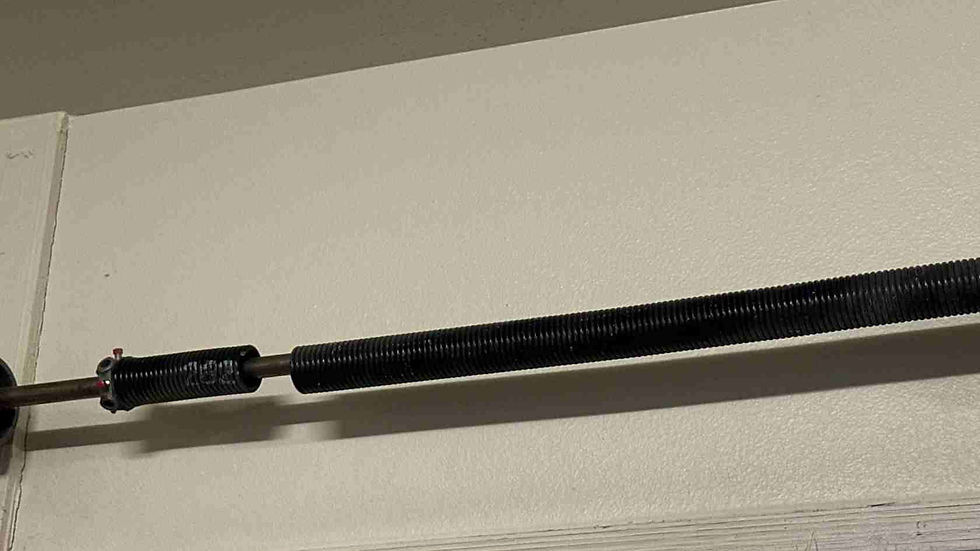
Torsion springs are the newer and stronger kind of spring system used in most current garage doors, particularly heavier doors or double-car garage doors. Torsion springs are mounted above the garage door opening using a horizontal torsion bar (metal shaft). Usually, they look like a solid black (or sometimes a metal) coil around the rod. Torsion springs work by twisting (winding) and unwinding; as it lifts and lowers the door. When the garage door is in the closed position, the torsion springs are completely wound up under a high amount of tension. Then, as the garage door opens, it slowly unwinds, while releasing spring power or energy as it raises the door. And as the garage door closes, it winds back up and stores the energy again - in a nice controlled manner.
Torsion springs generally provide a much smoother and controlled lifting force than the extension spring set up. Torsion springs typically lasts longer too - a standard torsion spring is rated for about 15,000 cycles or more. A high quality torsion spring can last 20,000+ cycles ultimately giving you many years of use.
Some doors use a single torsion spring setup for a one-car garage door; others use a pair of torsion springs by putting one spring on each end of the torsion bar and using one spring per door for a two-car wide garage door or a heavier door. If one torsion spring breaks, in a 2-spring system, it's considered standard practice to replace them both so they will be balanced and wear at equal lengths.
One benefit of torsion spring systems is, if they break, they pretty much stay on the torsion bar. You may hear a loud bang and find that the door itself is very heavy now, but usually broken torsion springs do not fly off like extension springs do, as they stay secured to the rod or shaft. You will see and notice a gap in the coil of the spring if it has broken.
Torsion spring systems use specific parts including cable drums on each end, and lifting cables or ropes to lift the garage door while the springs are unwinding. The cable drums roll up the cables to lift the door.
Identifying your system: If you see long springs that run the length of both sides of your door’s tracks, you have extension springs. If you see one or two springs that are wrapped around a shaft above the center of the door, you have torsion springs. Some older doors may even use a combination of both types and different configurations, but that is rare. Understanding the spring type is helpful when talking repairs or maintenance with a professional.
Why Garage Door Springs Break (and Signs of Trouble)
Garage door springs endure a heavy workload on a daily basis and will eventually fatigue. Below are some of the contributors to spring failure:
Wear & Tear: Springs all have a limited life span in terms of cycles. To calculate the cycles you must count each time your garage door opens and then closes. Standard springs (approximately 10,000 cycles) will typically last between roughly 7 and 10 years with normal usage. However, if you open and close your garage many times per day or if you have multiple drivers in the house who use the garage, the cycles can add up quite quickly. Eventually, the metal will fatigue and the spring will lose its ability to hold tension, which creates a break.
Rust & Corrosion: Steel springs will corrode and rust in the presence of moisture & humidity. As the iron oxide forms in this process, the rust will corrode the metal, but also create some friction on the coils as they unfurl and elevate your garage door. Each time the rusted spring is flexed it will become more and more brittle. At some point, a rusted spring will become too brittle for use and ultimately snap. A preventative measure is to put a thin coat of garage door lubricant (a spray-on oil or silicone that is for springs) onto the spring a couple of times a year, this helps to prevent rust as well as limits the friction involved as the springs spool.
Lack of Maintenance: Simple maintenance can extend the life of your springs. Maintaining (or lubricating) your springs is not the only thing you can maintain. Getting a professional to inspect your garage door and properly balance it periodically will find a weak spring before it fails. If you have a spring that's starting to stretch or if a door gets unbalanced, the technician will adjust spring tension or inform you the spring needs replacing before the break occurs at a most inconvenient time; you really don’t want them to break and be stuck at the garage door every day. The lack of maintenance leaves you at the most vulnerable to failure as you probably won't find the problem until the spring fails.
Cold Weather or Sudden Change: Cold Weather does matter to a degree when it comes to metal springs. Sometimes the metals become a bit brittle when the temperature drops rapidly. (This is a fact some homeowners realize when they can't open their garage door on a cold morning.) While it doesn't get excessively cold in Orange County, the changes in temperature from hot to cold quickly or just the passing of time can cause metal fatigue in your springs.


How do you know if a spring is on its last legs or has broken? Look for these signs of spring problems:
Visible gaps or breaks: Inspect your springs by taking a look at them while the door is closed, and without touching them. If it’s a torsion spring, see if there is a gap in the coil, or if the coil looks deformed or irregular. If you have extension springs, look for either a break in the spring, or separation. A broken spring is usually at least somewhat obvious to spot.
Door feels heavy or won’t open: If you suddenly notice you can’t lift the garage door or the electric opener is straining and failing to open the door, it is likely a spring that broke. The opener may try to lift the door a few inches, and then stop or reverse – that’s a built-in safety if the door is suddenly heavy (because the spring isn’t helping). You might also notice the door drops quickly when closing, that’s a dead giveaway of lost spring tension.
Uneven movement: If one extension spring snaps, one side of the door simply won't be supported properly. As the door is moving, the door may jerk, or it may become crooked, or one top corner may lag behind the other top corner. In this case, it is best to stop using the door to avoid any further damage.
Loud Bang Sound: Often homeowners hear a loud gunshot-like bang in the garage and are not sure what it was. Often, this is the sound of a spring breaking. Springs release a tremendous amount of energy in a split second when they fail, it makes an unmistakable noise.
Gaps at the garage floor: If the garage door was closing fully before, but now you have a gap at the bottom, on one side, this may indicate a spring (or a cable) issue creating uneven support.

If you see any of these signs, stop using the door until it is repaired and serviced. Using a garage door with a broken spring can cause more damage ( for example, burning out your opener motor, distorting the door panels) and can be unsafe.
The Dangers of DIY Spring Replacement
It may seem like a good idea for a handy homeowner to replace garage door springs as a DIY project. Why not? Instructions and kits exist; perhaps you are the handyman type and used to fixing things around the house. But, garage door spring replacement is one of the most dangerous DIY jobs that you can undertake. Here are reasons to think twice:
High Tension = High Risk: Both extension and torsion springs are under a huge amount of tension. When a spring is loaded (wound or stretched), a spring can hold huge amounts of stored energy. If this energy is suddenly released in an uncontrolled fashion, it can cause serious injury or death. For example, if a torsion spring unwinds unexpectedly, its force can whip a metal winding bar around with enough kinetic energy to break bones. An extension spring can also turn into a flying piece of shrapnel, in the absence of a safety cable.
Possible Injury: Garage door spring accidents have caused horrifying injuries, like deep lacerations, shattered hands or fingers, eye or head injuries. Even professional technicians who are trained, take extreme care while working with springs. With this being said, it is not surprising to hear that experienced garage door technicians have stories about close-call accidents or injuries. If professionals, who do this for a living, treat springs with caution, this is a good indication you, as a casual DIYer, should have caution!Specialized Tools and Knowledge: It is more complicated to replace springs than merely turning a couple of bolts. Torsion springs, in particular, require steel winding bars of the correct size to properly and safely wind and unwind the spring. Using makeshift tools in place of a proper wrench (like a Phillips screwdriver or an inappropriate rod) tends to slip out of the winding cone and will cause injury. Proper vice clamps are needed to secure the torsion shaft, correctly sized wrenches for the set screws, and ideally a good understanding of how the door mechanism operates. Most of the time it is the wrong tools or misjudging the job’s level of complexity that leads to trouble for the DIYer.
Choosing the Right Spring: There is no one-size-fits-all spring. Doors differ in weight, height, and to some extent design characteristics, and springs likewise differ in length, wire gauge, and strength to complement all the door variations. Using the wrong size spring could make the door too heavy to lift or it could cause the door to fly up (this can lead to danger and/or opener damage). Determining the correct spring can be done by measuring the old spring or weighing the door. It is very easy for an inexperienced individual to get this wrong, and waste money (and time- it still won’t work correctly). Professionals like OC Garage Door Guys have a wide range of spring sizes on hand and can readily identify and install the right spring for your unique door.
Time & Hassle: Even if you avoid injury, replacing a spring with a DIY method can still take a great deal of time and hassle. Rebalancing the door after replacing the new springs is often tricky – if you don’t wind the torsion springs the same number of turns or if extension springs are not equally tensioned, the door may not stay balanced. You could easily waste an entire weekend working on it, but a trained technician will most likely be able to replace springs in under an hour. Please consider the value of your time (and stress) when performing a repair such as this.
Damage to your Door or Opener: Some dangers can be avoided but can lead to collateral damage to your repairs. If you simply let the torsion spring unwind without proper security of the torsion bar, the torsion bar can turn recklessly which could bend the garage door tracks – or worse – the torsion bar itself. You could also release a garage door when either the spring has broken or it is out of balance, and it slams down which could lend force enough to bend door panels and/or knock rollers off the track. And, if you let the garage door fall you could damage whatever is below it (your car, tools or concrete). A professional understands how to safely prop and secure your door while they resolve repairs to mitigate this risk.
Benefits of Professional Spring Replacement (Why Choose OC Garage Door Guys)
When you weigh the hazards and potential pitfalls of DIY projects, having a professional replace your garage door springs typically is the smartest choice. Here are the reasons that a company like OC Garage Door Guys can be helpful:
Safety: Professional technicians are trained to do the job safely. These technicians almost do spring replacements every day of their lives and have learned how to do the job while minimizing the risk of injury. Ultimately, when you are considering hiring someone to do your spring replacements, you could be keeping yourself and your family out of harm's way. They'll also ensure that the workspace remains safe, all heavy lifting and high-tension adjustments will be completed without you required to worry about safety!
Knowledge and Tools: A seasoned garage door technician will arrive with plenty of tools that are specialized and designed specifically for the job (winding bars, tensioning tools, wrenches, and more). They'll also come with the knowledge of countless spring replacements, which takes out one more chance for any surprises that may send a DIY project spiraling out of control. If your door happens to utilize an unconventional spring system or has other similar issues, a technician will know what to do right away and be well equipped to complete the job.
Sizing the Springs: Professionals will also identify the exact type and size of spring required for your garage door's weight and design. As noted, there are many different spring designs, sizes, and strengths. Technicians with OC Garage Door Guys carry a wide range of spring inventory and will select an appropriate spring to ensure that your garage door is balanced and will last for many years to come.They will usually replace both springs in a two-spring situation to keep the door level, a fact a homeowner may not think to ask.
Time Saving and Convenience: What you may take hours (or even a weekend) to do and a lot of frustration, can be completed by a professional in one short trip. For example, our OC Garage Door Guys typically replace a broken spring in under an hour, allowing your garage door to become operational again in a timely manner. We also take care of the mess, including disposal of the old broken spring, freeing you from doing it.
Preventing Worst Case Scenarios: A well-trained technician doesn’t just replace the spring and called it a day. The technician would also assess whether the rest of the garage door system was in good shape. This includes checking cables, rollers, pulleys, and assessing the current state of the garage door opener. We would also ensure a proper balance and alignment after the new spring is installed. A properly balanced door puts less stress on the garage door opener and other components to reduce future problems. Not to mention, by investing in the best condition of your garage door system is to minimize the risk of future incidents.
Warranty and Peace of Mind: Reputable companies such as OC Garage Door Guys stand behind their work. When we replace springs, we usually provide a warranty that covers both the parts and the labour. If any issue arises as a result of our service, we will fix it. That sort of guarantee just isn't present when doing a DIY job. Being able to sleep easy knowing that the job was professionally done correctly and that you have a warranty (in case anything happens) is genuine peace of mind.
Professional Suggestions: Our Technicians are more than willing to answer your questions as well as offer suggestions for maintaining your garage door. They may suggest periodic lubrication of your new springs, or let you know if anything else in the garage door system may require future repairs. Personally written suggestions will help keep your garage door in top condition for a prolonged time, saving you money in the long run.

When it comes to garage door spring replacement, remember this simple advice: stay safe and let the pros handle the springs. Your future self (and your uninjured fingers) will thank you!