
Diagnosing and Fixing an Uneven Garage Door
Updated: Aug 29
A crooked or uneven garage door frequently points to a mechanical issue requiring immediate care and attention to detail. This inconsistency is identified when one side of the door travels up or down quicker than the other or if you notice it tilting or shaking during operation. Typically these situations are caused by imbalances or mis- alignments in the garage door operation. To begin your evaluation as a courtesy, watch the door closely as it travels, listen for noises (grinding, jerking or clanking) from the rollers and examine whether one side is higher or lower than the other.
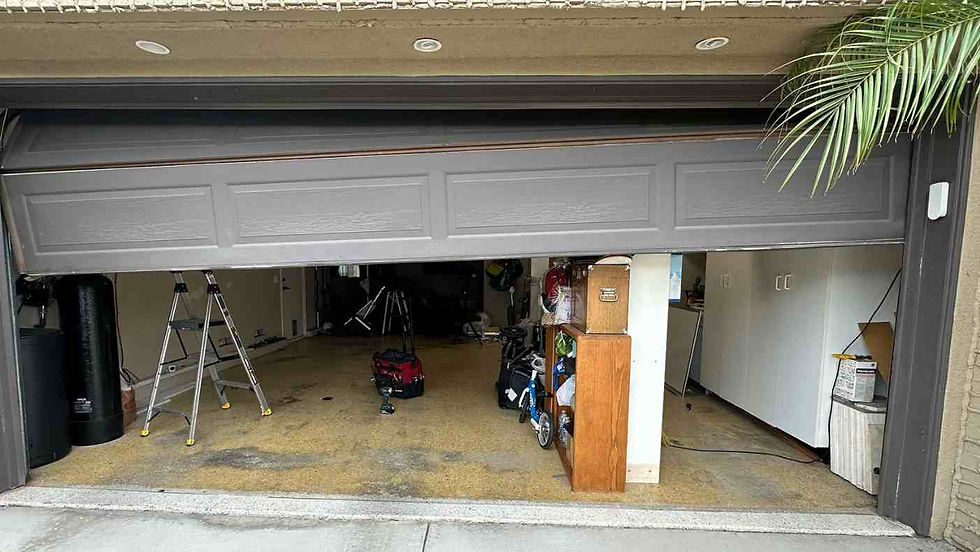
Next, check to see if the door holds level in the open position, approximately half-way. If it raises or falls by itself during this position, this points to an imbalanced spring or cable issue. After taking these observations into account, you are now prepared to evaluate some of the common causes of door operation problems such as tracks misalignment or kinked, improperly balanced spring tension, rollers that are worn, or door obstructions.
Taking the time to assess the door operation first will help you make the correct decision and prevent unneeded repair.
Safety First
Before doing any work on garage doors or operators, im- mediately disconnect the opener. This helps reduce the possibility remembering to have caught the door before operating unless you really wanted it to move. Pull the release handle (usually a red cord) to operate the door manually. You should clamp the door, with clamps or C-clamps, to hold the door in place on the bottom track (on the bottom rollers both left and right side) so the door cannot slip off onto you while you are trying to make repairs.
While working do NOT let the door travel freely. Wear heavy-duty gloves and safety glasses. Be especially cautious when dealing with springs or cables that are under tension. The ladder you use should be solid and safe to operate from.
It is advisable to have at least one other person to assist if you need to access the tracks above the header or to handle heavy loads. Caution: Torsion and extension springs can store extreme energy. That is why appropriately adjusting and replacing springs can be dangerous.
When you are uncertain or dealing with a complicated situation (i.e. a completely off track door or a spring that is obviously broken) it is not be a bad idea to engage a 2nd technician or senior technician for a supporting role.
Diagnosing an uneven door.
Conducing a methodical inspection:
Balance Test: Make sure the door is closed and also disengage the opener, raise the door with your hands to the mid-point and it should hold there. If it falls or move up on its own, the springs is out of adjustment or broken.
Visual alignment: measure the distance each track is from the sidewall or adjacent frame. The vertical tracks should be plumb (straight down up and down) and parallel on both sides. The horizontal tracks should rise slightly-uphill from the back towards the front so the door can travel smoothly down the tracks. If you see any settled or different visible orientation you have a vertical or horizontal misalignment issue.
Roller inspection: Look at each roller in the track. If any of the PLC rollers are rusty, have flat spots, broken chips, or wobbling. If one side's rollers are heavily worn, it may offset the door from center.
Hardware: Check the hardware to ensure all nuts, bolts, and brackets are properly tighten. If track brackets or hinge screws are loose, it allows one side to sag. Give the brackets and hinge a slight shake, if it moves you have a hardware issue.
Cable and drum check: Look at the lifting cables of each side drum. They should be equally tight. If one of the side cables is broken or fraying, the lifting will not be equal. The drums are wanted inspection/replaced for cracks or other damage. (note: don't want to mess with the cable tension or fix a broken cable. If a cable comes off or breaks, you may need to call for help.)
Clutter: Check the tracks and down on the floor for clutter or any obstructions.Small items, rocks or even hardened grease may be what's causing one roller to be binding which is causing the door to pull in an uneven manner. Remove the foreign objects and gently wipe the tracks with a dry cloth to clean. Do not over-lubricate the track itself as too much will attract dirt.
After going through these checks, you should have a better understanding of what the problem is. You will probably find more than one issue (loose hardware and not good rollers, for example), so be ready to handle multiple repairs.
Track Misalignment
Misalignment can be evident if: The door is rubbing or squeaking on one side, or there is a discernible gap between the rollers and the track rail. If a track is bent (or knocked out of place from a collision or while shifting a heavy load) or has one roller that is jammed somewhere, the door is going to bind and move crookedly.
To correct the aligning: With a wrench or socket, loosen all nuts and bolts on any loose track brackets. Once the bolts are loose, tap the one track back into true alignment with a rubber mallet or block of wood. Use a level to ensure the vertical sections of the tracks are perfectly plumb. For the horizontal tracks, just make sure they are pitched correctly (slightly up from back to front). Once you are aligned, tighten all the bolts firmly.
If one or section of track is very gently dented, take your time and try to work it back to it's original shape by hand or with a mallet. Severely bent track sections need to be replaced.
Tighten all track brackets, and hinge screws. Even slightly loose components can allow a track to shift under operation.
If your minor bends persist after tightening the track, loosen the bracket once again and bend the track to straighten it out, then retighten the bracket.
If you find that the tracks constantly bend at your installation, you might want to think about exchanging roll-formed (thin) tracks with heavier roll-up style tracks.
After you are done adjusting the track, wipe them down with a rag and lubricate your rollers slightly (do not lubricate the track surface) so they will travel smoothly.
After you have adjusted the tracks, always adjust and test the door again: run it manually to verify that the rollers run freely without binding up or jumping out of the track.
Spring Tension Issues
Signs of imbalance include: there is a heavy or low side to the door, the door will not stay half-open. A broken torsion spring will usually have a loud bang and a gap in the coils. If the door has a heavy feel to it or seems uneven, the springs need to be adjusted or possibly replaced.
Diagnosis will depend on the type of spring you are working with. Check the torsion springs (above door). Count the turns on each side of the door; they should match. For extension springs (above each horizontal track) the lengths and tension on each side should be similar also. If one spring looks shorter and/or stretched to a different length, or has a broken coil, it is the defective spring.
Adjusting Torsion Springs (these are the springs that are mounted above your door):
Preparation: Make sure the door in closed position, elbows are in place. Use safe and proper winding bars; never use screwdrivers as improvised winding bars. Eye protection is recommended.
Mark Springs: Chalk or mark the existing position of the winding cone so you can make adjustments as described below.
Loosen Set Screws: As your winding bars are seated securely in the cones, you can use your socket wrench to loosen the set screws slightly. Keep the tension on the spring under control as you manipulate the bars.
Make Small Adjustments: Insert the winding bar back into the cone and make a quarter turn (or however much is needed) to tighten or loosen the tension. Take your time with the adjustments: every time you make a quarter turn, you need to retighten the screws and test the balance of the door. Increasing the tension raises the door; relaxing the tension lowers the door. Do not make larger adjustments than one quarter turn at a time.
Test: Re-engage the opener and test run the door. Watch for even travel. If it does not, you may have to start over with the small adjustments.
Replacement: If a torsion spring is broken or simply too old, replace both springs as a set. Always use new springs that are rated for the weight of the door. If the extension springs are worn, replace them also as pairs.
Safety tips: Always use two winding bars for torsion springs, one in the cone, and one as a backup. Never let go of a winding bar until the set screws in the cone are fully tightened. If you do not feel confident to do this, please call a senior technician. Changing springs is risky, and two people should be present to hold ladders and help guide the door panel whenever necessary.
Worn Rollers (and Hinges)
Observation: If you notice jerky or noisy movement when you're opening or closing your garage door, especially if it is primarily on one side, your rollers may have gone bad. Check all the rollers and note any rollers that have rust buildup, flat spots or seized bearings. Nylon rollers are quieter and experience wear less quickly than stamped-steel rollers but can fail just like any other type of roller.
Repair Steps
Rollers: After clamping the door so it is secure, either using your pliers or wrench, remove either the hinge bolt or the C-clip that is holding a bad roller in position. Remove the roller from the track and replace with a new roller that is the same type (same composition). Nylon rollers will typically have a retaining clip and steel rollers will typically use a bolt/nut. Replace one roller at a time.
Lubrication: After the roller is installed, lightly lubricate the roller axle with some silicone or lithium garage-door lubricant (not WD-40 because it dries out). Spin the roller to distribute the lubricant.
Hinges: While you are replacing rollers, check each hinge that connects the door panels. A bent or broken hinge could cause a door panel to shift and become out of alignment. Tighten the screws of any loose hinges, and replace any damaged hinges.
If a number of rollers on one side of the door is defective, you may wish to replace all of the rollers on that side in order to restore evenness and smoothness. Regardless of the number of roller replacements, test your door when you are done - your new set of rollers should allow your door gliding smoothly.
Debris/Blocking
Sometimes the problem of uneven travel is nothing more than simple debris or obstructions. Even minimal obstructions in one track could cause the other side to stick. Inspect each track path for debris; you may find loose leaves, grit, tools, etc. If necessary, vacuum out the loose dirt/dust. Wipe the inside of the track clean with a rag.
Also check the bottom rubber seal: if the seal is folded under (common problem), or snagging on the floor on one side, it will hold the entire door up on that side. Cut the folded seal or replace it if it is distorted. You could also check that the door is not hitting weather stripping or matting on one side. Finally, confirm that the lifting cables are properly seated on the drum and not slipped out of groove.
A cable that is off of its drum will wind unevenly creating a sagging door to that side. If a cable is off, clamp the door, unwind tension carefully, reseat the cable on the drum, and then retighten the spring. Since cables and drums are under tension, if you need to perform this be sure to have another tech or supervisor assist you.
Final Testing and Adjustments
After every repair, retest the door. Disconnect the opener power and move the door manually; it should move smoothly and hold all types of level by itself. Reconnect power and cycle the door while you watch the door from a safe distance.
Listen for anything that sounds like rubbing or grinding. If it still appears as an uneven moving door, revisit each area, Sometimes both track adjustments and spring adjustment are needed together. Continue repeating adjustments in a small amount until the door is moving properly.
When the door is level and quiet operation, perform a final safety check and make sure all clamps and tools are removed, all fasteners are tight, and the opener operates the door without issues and that the sensors align properly.
When to Call For Back Up or Senior Help
Even as a seasoned technician, know your limits. Some tasks are high risk like spring adjustments, cable replacements, and realigning a door that is severely and deeply off its tracks.Always have a second person when doing:
Torsion springs: Two people will be better at handling heavy windings and ladder support.
Door off-track: If the door has jumped off the track or if the panel is loose, lots of times it's pretty heavy. It takes two people or more to lift a panel back in the ballpark.
Heavy doors: Double car or insulated doors are extremely heavy; don't ever attempt a panel replacement or torsion assembly change alone.
Things found that were un-expected: If you find parts broken (like a cracked cable drum) or if the door slightly behaved differently when changing from your repairs, DO NOT IGNORE IT. Call the senior tech, don’t continue on their recommendations; they may have you order parts or bring specific tools before continuing on.
Don't forget; Safety, thoroughness then speed. If it means taking a little extra time or calling for help; then don't risk injury or repeat call-backs.
Maintenance tips (to prevent further problems).
If there is a way to prevent an uneven operation; it is regular maintenance.
1. Lubricating moving parts: Remember to lubricate rollers, hinges, and bearings every 6 months. (and no; don't over-lubricate the tracks).
2. Tightening: Nuts, bolts, and screws should be checked and tightened on occasion; it is easy for them to loosen up due to vibration.
3. Balance test: With the opener disconnected; once a year perform your balance test on the door. If it drifts; adjust or replace the springs.
4. Track cleaning: Inspect the tracks and remove any debris. Following a snow or storm season be sure to inspect for any build up.
5. Safety cables: Depending on whether your system has extension springs; make sure to inspect the safety cables (this keeps springs from flying off if they break). Replace any cables that are frayed or showing significant wear immediately.
A solid regular inspection program will catch many minor items prior to causing an uneven operation. Since regular checks are needed for smooth-operation consider emphasizing to the homeowner the importance of checking regularly.
Well maintained garage doors will therefore keep the home owners safe, and everyday installations will take considerably less time. If you follow this plan, and can diagnose logically, attend to problems with caution, consider your surroundings, then you can correct the problem of an uneven garage door back to smooth and balanced operation.
You will always be aware of the behavior of a door after your repairs, and allow for another person or senior tech to get involved if you need either assistance or expertise, or both!